Following a 2000 proposal to Royal Roads University (RRU) to develop a graduate program in environmental education and communication, Dr Milton McClaren (one of the fathers (indeed, perhaps grandfather) of environmental education in British Columbia) was charged by then-Dean Steve Grundy to find someone to co-develop and lead the program.
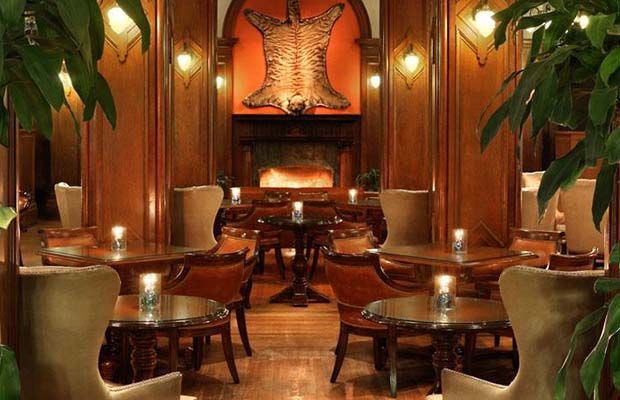
Milt invited long-time friend and colleague, Dr Richard Kool, then working in the BC Ministry of Environment, Lands and Parks as the Environmental Education Coordinator, to a key meeting in the Bengal Room at the Empress Hotel in downtown Victoria.
Over glasses of amber liquids, Milt laid out his ideas: a program that would be designed for early to mid-career individuals working in public relations, journalism or mass media, education, instructional design, corporate communications, community development and more.
“Royal Roads is… uniquely positioned to play a strategic role in developing the leadership needed to foster wider public environmental literacy, to find effective solutions to environmental problems, and to develop new environmentally sustainable businesses and industries or to restructure existing ones” (Milton McClaren).
The die was cast. Rick received a contract from RRU to operationalize the idea crafted by Milt, and, the Master of Arts in Environmental Education and Communication (MAEEC) program began to emerge.
“In that RRU was not wedded to strict disciplinary boundaries for its academic programs, we could be wildly interdisciplinary, even transdisciplinary, bringing together aspects of learning that were ‘curated’ to provide a unique opportunity for prospective ‘learners’, transcending what a more traditional MA might cover” (Richard Kool).
Through 2001, Rick and Milt crafted a document for RRU fleshing out the ideas that would be the foundation for this new program.
Because RRU was not wedded to strict disciplinary boundaries for its academic programs, the program was evolving towards being wildly interdisciplinary, or even transdisciplinary, trying to bring together aspects of learning, ‘curated’ to provide an opportunity for our students (referred to as ‘learners’ at the time) to transcend what a traditional MA would cover. And different too from many other graduate programs, the new program would, like all RRU programs at that time, insist the the course of study would be done in sequence, with a cohort, over both on-campus residencies and distance-based on-line terms; there were no electives, no options. A MA thesis would be the capstone for the program.
The emerging program actively combined study in natural sciences, social sciences and humanities, offering students a range of academic and experiential opportunities not easily gained elsewhere. There would be courses in learning theory and educational practice, as well on environmental education and environmental communications; but these were the expected core of an MA in this domain. A highly-practical course in instructional design was offered early in the program. However, we also added things that were not part of a ‘normal’ MA in either environmental education or environmental communication.
We proposed presenting a course in environmental science, thinking that our students needed to have a reasonably solid basis in the science of what is going on in the biosphere. As many people either get involved in environmental activity because of conflict, or generate conflict as a result of their actions, we wanted to offer a course in conflict analysis and resolution. Because conflict is often a result of conflicting worldviews, we proposed a course on worldviews and ethics. A research methods course was designed to prepare students for their thesis work, although we would end up being completely open to alternative forms of academic theses including elaborate and innovative websites, documentary movies and more.
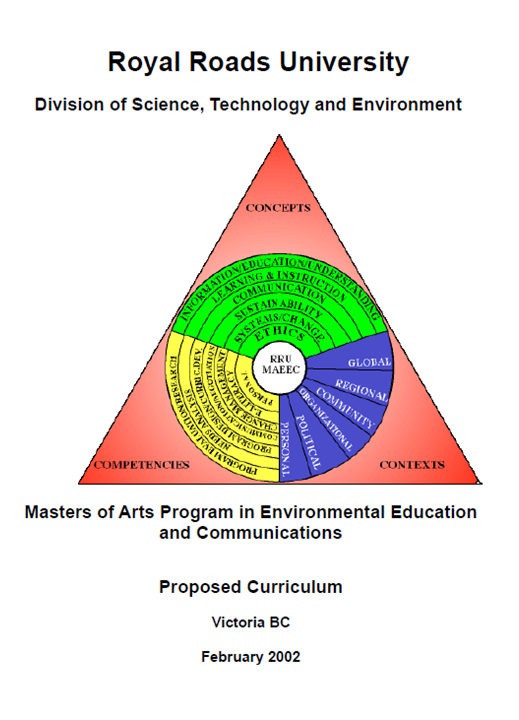
Based on the plan submitted to RRU in February 2002, Rick was hired in January 2003 to establish the MA in Environmental Education and Leadership (MAEEC) program.
Seven months later in the summer of 2003, 20 students joined in the inaugural residency. Also joining us that first residency was Dr. Bill Hammond, a deeply-loved and respected leader in the environmental education field; Dr. Jennifer Good, a newly hired faculty member at Brock University (St. Catherine’s Ontario) and an up-and-coming recent graduate from Cornell University in environmental communications; and Dr. Dillon Inouye (learning theory expert) and Dr. Bob Bennion (psychologist and therapist). Of course, Milt joined in the cohort and Rick’s job as head of the new program kept him nervous and hopping for the initial three-week residency.
Least-developed in our thinking at the outset of the program was the final (third) residency and the final course, which we imagined would be a capstone event that focused on leadership. And while over the first 15 or so years of the program some courses were dropped and others added (e.g., environmental psychology), it was the leadership course in the third residency, initially developed by Milt and the inspirational and somewhat quirky Peter Norman, that carried its own special meaning for students, alumni and faculty.
It was for this final residency that “The Box” was created.